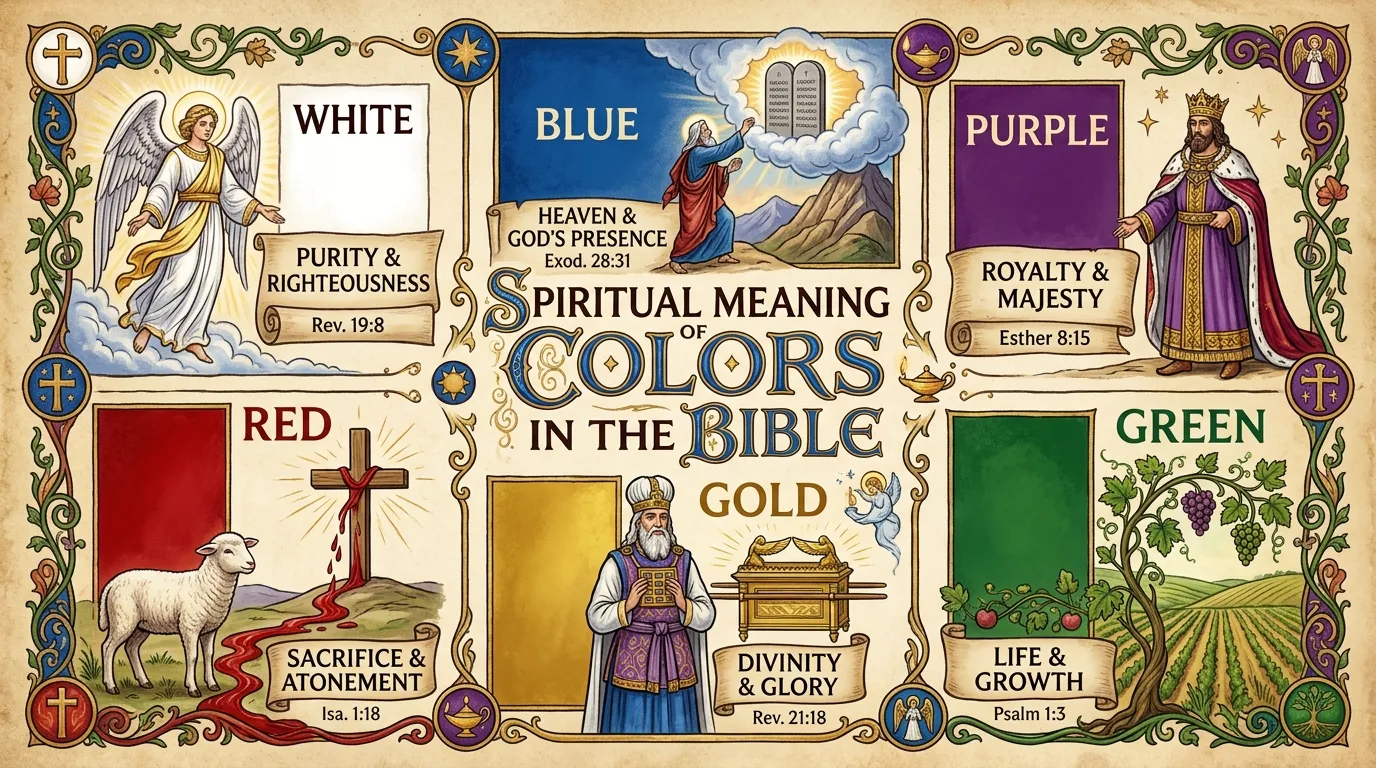
Colors are used throughout the Bible to communicate spiritual truths and reveal important aspects of God’s character, His promises, and His relationship with humanity. From the colorful garments of priests to the visions described in Revelation, biblical colors often carry symbolic meaning that helps believers understand deeper spiritual lessons.
The spiritual meaning of colors in the Bible is not about secret codes or mystical interpretations. Instead, these colors serve as visual reminders of biblical themes such as holiness, redemption, faith, royalty, judgment, and eternal life.
Imagine reading a story where every color points to a greater message. In many ways, that’s how colors function in Scripture. They help paint a picture of God’s plan and His work throughout history.
Many Christians study biblical colors to better understand Scripture and appreciate the rich symbolism found throughout God’s Word.
As we explore the spiritual meaning of colors in the Bible, we will discover how different colors represent important truths about faith and God’s kingdom.
White: Purity and Holiness
White is one of the most significant colors in the Bible.
It often symbolizes:
- Purity
- Holiness
- Righteousness
- Victory
- Cleansing from sin
“Though your sins are like scarlet, they shall be as white as snow.” — Isaiah 1:18
In Revelation, believers are pictured wearing white robes, representing their cleansing and redemption through Christ.
Spiritual Meaning of White
White reminds believers of God’s holiness and the forgiveness available through Jesus.
Red: Sacrifice and Redemption
Red is commonly associated with blood and sacrifice.
It symbolizes:
- The blood of Christ
- Redemption
- Atonement
- Salvation
- God’s covenant
“Without the shedding of blood there is no forgiveness.” — Hebrews 9:22
The red blood of sacrificial offerings in the Old Testament pointed forward to Jesus’ ultimate sacrifice on the cross.
Spiritual Meaning of Red
Red represents God’s love demonstrated through sacrifice and redemption.
Blue: Heaven and Divine Truth
Blue frequently appears in descriptions of priestly garments and sacred items.
It symbolizes:
- Heaven
- God’s presence
- Divine truth
- Faithfulness
- Spiritual devotion
God instructed Israel to include blue threads in certain garments as a reminder of His commands.
Spiritual Meaning of Blue
Blue encourages believers to keep their hearts focused on God and heavenly things.
Purple: Royalty and Kingship
Purple was a rare and expensive color in biblical times.
It often symbolized:
- Royalty
- Authority
- Wealth
- Honor
- Kingship
Jesus was clothed in a purple robe before His crucifixion, symbolizing His identity as King.
Spiritual Meaning of Purple
Purple points to Christ’s kingship and God’s sovereign authority.
Gold: Glory and Divinity
Gold appears throughout the Bible, especially in the Tabernacle and Temple.
It symbolizes:
- God’s glory
- Divinity
- Majesty
- Purity
- Eternal value
The Ark of the Covenant and many sacred objects were covered in gold.
Spiritual Meaning of Gold
Gold represents God’s greatness, holiness, and eternal nature.
Green: Life and Spiritual Growth
Green is associated with nature, life, and flourishing.
It symbolizes:
- Growth
- Renewal
- Prosperity
- Hope
- Abundant life
“He makes me lie down in green pastures.” — Psalm 23:2
Green reflects God’s provision and care.
Spiritual Meaning of Green
Green reminds believers of spiritual growth and God’s sustaining power.
Black: Mourning and Judgment
Black is often connected with difficult times in Scripture.
It can symbolize:
- Mourning
- Famine
- Suffering
- Judgment
- Spiritual darkness
However, black does not always represent evil; sometimes it simply reflects grief or hardship.
Spiritual Meaning of Black
Black reminds believers of humanity’s need for God’s light and redemption.
Scarlet: Sin and Sacrifice
Scarlet is a vivid red color frequently mentioned in Scripture.
It symbolizes:
- Sin
- Sacrifice
- Cleansing
- Redemption
“Though your sins are like scarlet…” — Isaiah 1:18
Scarlet often highlights humanity’s need for God’s forgiveness.
Spiritual Meaning of Scarlet
Scarlet points both to the reality of sin and the hope of redemption.
Silver: Redemption and Value
Silver was widely used in biblical offerings and transactions.
It symbolizes:
- Redemption
- Purification
- Truth
- Value
Silver was often associated with the price paid for freedom or deliverance.
Spiritual Meaning of Silver
Silver reminds believers of the cost of redemption and God’s refining work.
Brown: Humility and Humanity
Although not emphasized as strongly as other colors, brown can symbolize:
- Earthliness
- Humility
- Simplicity
- Human nature
Since humanity was formed from the dust of the ground, brown often reminds believers of their dependence on God.
Spiritual Meaning of Brown
Brown reflects humility and the reality that life comes from God.
Colors in the Tabernacle
The Tabernacle used several important colors:
- Blue — Heavenly truth
- Purple — Royal authority
- Scarlet — Sacrifice and redemption
- Gold — Divine glory
- White linen — Holiness and purity
Together, these colors created a visual representation of God’s holiness and salvation plan.
Do Biblical Colors Have Special Power?
The Bible does not teach that colors possess supernatural powers.
Instead, colors serve as symbols that help communicate spiritual truths.
Believers should focus on the biblical message behind the colors rather than treating them as mystical signs.
The power lies in God’s truth, not in the colors themselves.
Practical Lessons From Biblical Colors
The colors of the Bible remind believers to:
- Pursue holiness (White)
- Remember Christ’s sacrifice (Red)
- Focus on God (Blue)
- Honor Christ as King (Purple)
- Worship God’s glory (Gold)
- Grow spiritually (Green)
These lessons can enrich personal Bible study and deepen faith.
Conclusion
The spiritual meaning of colors in the Bible reveals rich symbolism that points to God’s character, His promises, and His plan of salvation. Colors such as white, red, blue, purple, gold, and green each communicate important spiritual truths about holiness, redemption, faith, royalty, glory, and growth.
While colors themselves do not hold spiritual power, they serve as powerful reminders of biblical principles and God’s work throughout Scripture.
Remember this encouraging truth:
Every color in God’s creation reflects His creativity, and many biblical colors point believers toward deeper understanding of His love, holiness, and eternal promises.